
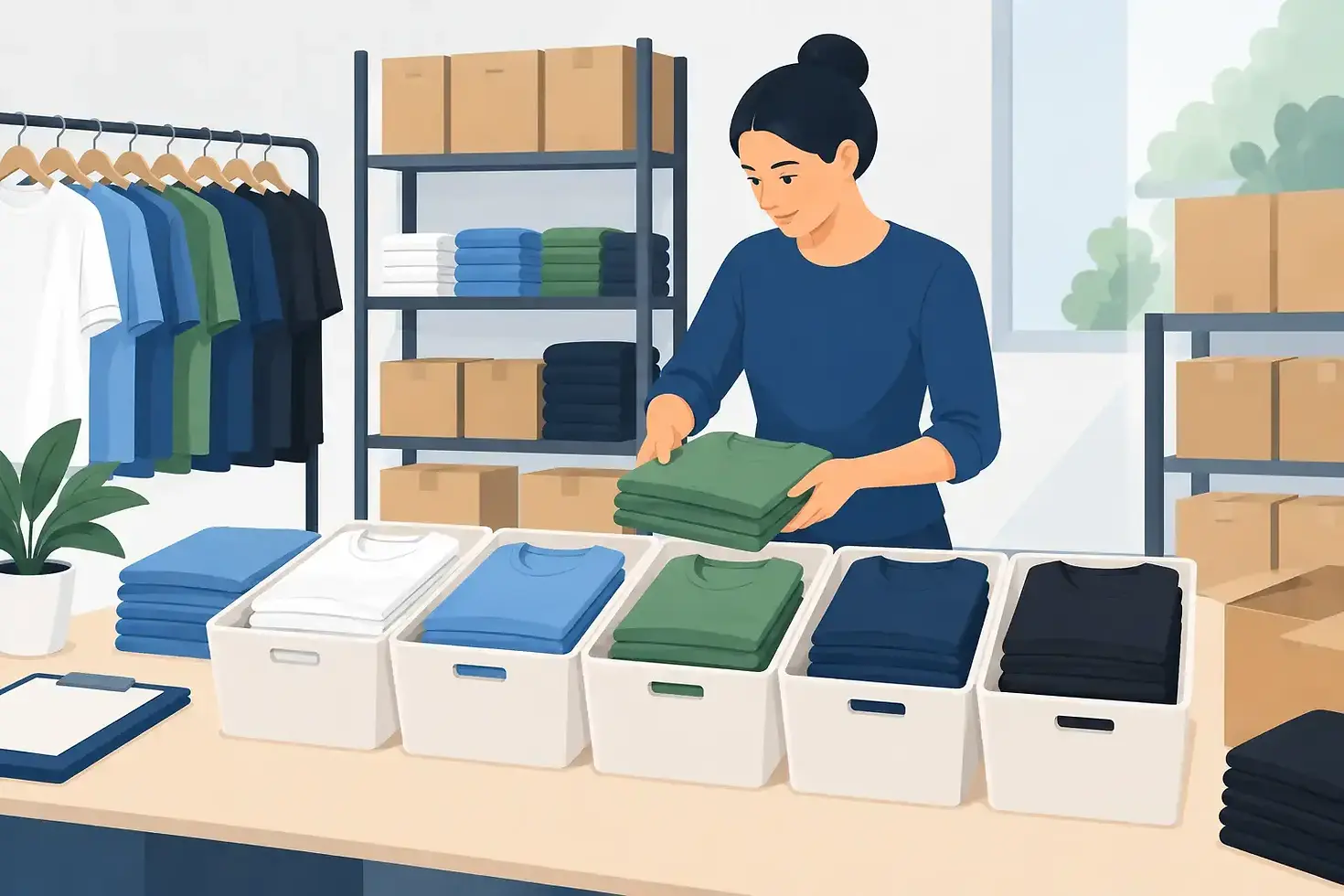
How to Organize Bulk Apparel Sizes Without Waste
A bulk apparel order can look simple until the size breakdown arrives. One department needs polos for 18 office employees, the field team needs safety shirts, and a few new hires have not started yet. If you organize bulk apparel sizes with a clear process before production begins, you avoid the two most common problems: employees left without the right fit and shelves full of unused inventory.
For branded uniforms, event shirts, company stores, and employee recognition programs, size planning affects more than comfort. It influences budget, brand presentation, reorder speed, and how confidently your team wears the apparel you provide. The goal is not to guess perfectly. It is to build an order that reflects real people, real job functions, and a practical allowance for change.
Start With Individual Size Collection Whenever Possible
The most accurate size plan comes from collecting sizes directly from the people who will wear the apparel. This is especially true for premium pieces such as quarter zips, embroidered polos, outerwear, dress shirts, and safety apparel. These items have a higher per-unit cost and are often expected to become part of a regular work wardrobe.
Give employees a firm response deadline and use a simple size form that asks for their name, department, garment selection, and preferred size. If employees can choose between a men's, women's, or unisex fit, make that choice clear. A size medium in a unisex hoodie is not equivalent to a medium in a fitted women's polo.
Do not rely on what an employee wore in a different brand three years ago. Apparel sizing varies by manufacturer, cut, fabric weight, and garment category. A dependable supplier can provide size charts and help identify whether a style runs more relaxed, athletic, or fitted. That guidance is useful, but the wearer should still make the final size selection when possible.
For teams without regular email access, such as warehouse, construction, landscaping, manufacturing, or field service crews, supervisors can collect sizes in person. A printed size chart, a sample garment, or a short fitting session can prevent a costly round of exchanges later.
Organize Bulk Apparel Sizes by Garment, Not Just by Person
A common ordering mistake is creating one master size list and applying it to every item. People do not necessarily wear the same size in a T-shirt, polo, jacket, and button-down. The fabric, fit, and intended layering all change the decision.
Build your order sheet with each garment as its own section. For example, an employee may select a large performance polo, an extra-large fleece jacket to layer over workwear, and a medium cap with an adjustable closure. Separating the counts by item keeps the order accurate and makes proof approval easier.
This approach also helps when different roles receive different apparel. Your customer-facing sales team may need embroidered dress shirts and quarter zips, while operations employees receive moisture-wicking tees and high-visibility safety wear. Treating every group as one size pool can produce a misleading distribution.
Account for Fit Type and Intended Use
Before collecting counts, decide which fit options are appropriate for your team. Unisex garments can simplify ordering and work well for T-shirts, hoodies, and many outerwear styles. For polished corporate apparel, offering men's and women's cuts may improve comfort and professional appearance.
Also consider how the garment will be worn. A lightweight event T-shirt is usually ordered closer to a normal fit. A work jacket or full zip may need room for layers, tools, movement, or protective clothing. Asking one practical question - “Will you wear this over another layer?” - can improve size accuracy quickly.
Use a Size Curve Only When Individual Data Is Not Available
Sometimes you need to place an order before you can collect every size. A trade show giveaway, a recruiting event, a customer promotion, or a quick team launch may require a planned size curve instead of named selections. In that case, use past order history first. Your own employee and customer data is more useful than a generic apparel chart.
If prior data is unavailable, build a balanced distribution around common adult sizes, then adjust it for your audience. For a general adult unisex order, medium through extra-large usually represent the largest share of units. Small and 2XL should still be included in meaningful quantities, while larger extended sizes should reflect known needs and the purpose of the order.
A broad public event may justify more medium and large shirts. A skilled trades crew may need a heavier concentration in large, extra-large, and extended sizes. A wellness event with a more varied attendee base may require a wider spread across smaller and larger sizes. There is no universal curve that fits every organization.
Avoid making a size curve too narrow just to simplify the order. Ordering only mediums, larges, and extra-larges may save a few minutes at the start, but it sends the message that some recipients were not considered. Brand apparel works best when people actually want to wear it.
Add a Controlled Buffer, Not Random Extras
Extra apparel is smart. Random extras are expensive.
A buffer protects you from new hires, missed responses, damaged garments, late additions, and size changes. The right buffer depends on the purpose of the order. For a closed employee uniform order with confirmed selections, a small reserve of the most common sizes may be enough. For onboarding apparel or a company store fulfillment program, you may want a broader stock position across frequently requested sizes.
Keep buffer inventory tied to likely demand. If your records show that large and extra-large are consistently requested, placing a few extra units in those sizes is practical. Ordering several additional small or 3XL garments without a reason may create dead inventory, particularly when the item has a dated event logo or a role-specific decoration.
For evergreen company-branded apparel, a modest stock of core styles can support urgent hires and last-minute client visits. For annual events, seasonal campaigns, or team-specific uniforms, it is usually better to keep the buffer lean.
Check Minimums, Decoration, and Inventory Before Final Approval
Size planning does not happen in isolation. Product availability can change, and certain colors or sizes may have limited inventory. Before you approve the final order, confirm that every requested size is available in the selected garment and color.
This matters most with extended sizes, women's cuts, specialty safety apparel, and premium outerwear. A style may be stocked from small through 4XL in one color but stop at 2XL in another. If you discover that after an order is approved, you may need to substitute garments or split the order.
Decoration also affects your decisions. A large left-chest embroidery design may not work well on a youth size or a very small women's garment. Screen print placement may need adjustment across different size ranges. Reviewing a digital proof and discussing the full size run with your apparel partner helps protect the finished look of your logo.
At Stay Sharp Custom Apparel, this is where hands-on support matters. A team that understands both apparel and decoration can flag fit, availability, and logo-placement concerns before production, rather than leaving you to solve them after delivery.
Make Reorders Easier With Better Records
Your first organized bulk order should make the next one faster. Save the final size breakdown, garment style, color, decoration details, and the reason for the order. Note whether employees reported fit issues, whether certain sizes ran out first, and whether unused apparel remained.
For recurring uniform programs, keep a current roster with employee sizes and approved garment options. For larger organizations, a company web store can reduce the administrative burden by allowing eligible employees to select approved apparel within the right product and size options. It gives employees more ownership while maintaining brand consistency.
Reorder data is especially valuable when you are planning seasonal outerwear, annual employee gifts, sales meeting apparel, or safety programs. Rather than beginning with assumptions every time, you can use actual results to refine future counts.
Give Yourself Time for Corrections
Even a well-run size collection needs a cutoff date. Set it early enough to review responses, follow up on missing information, check inventory, approve proofs, and make corrections before production. Last-minute changes are more manageable before decoration begins than after logos are applied.
When timing is tight, prioritize the information that cannot be guessed: the garment style, fit type, color, logo location, and employee-specific sizes. A fast turnaround is valuable, but accuracy is what keeps the order from becoming an expensive scramble.
The best size plan is the one your team can use with confidence. Collect real data where you can, make informed allowances where you cannot, and keep records that turn every future apparel order into a simpler decision.


Comments