
How Long Does Embroidery Take for Orders?
A jacket order due before a trade show can feel simple on Monday and urgent by Wednesday. That is usually when the real question comes up: how long does embroidery take, and what can slow it down?
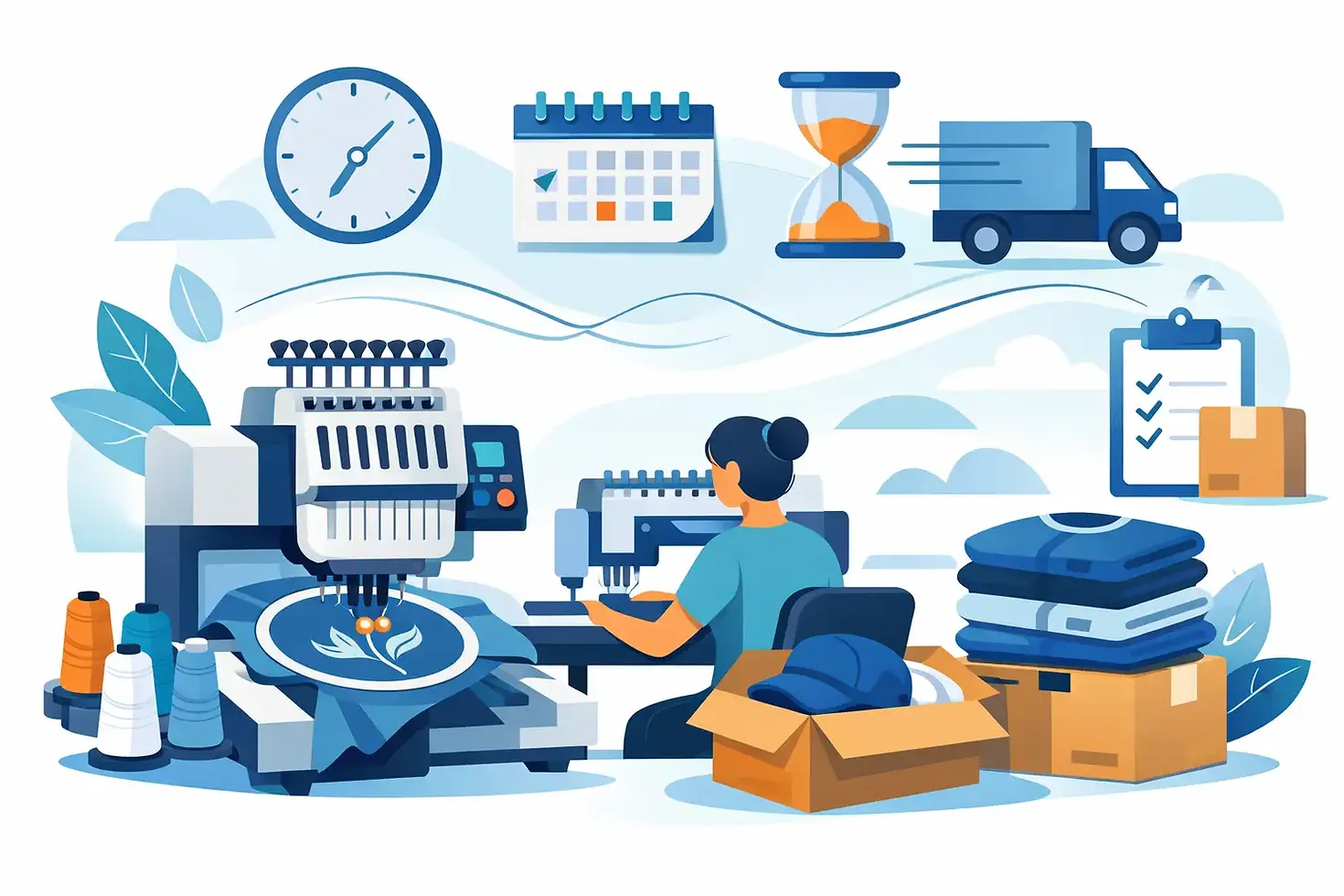
The honest answer is that embroidery timing depends on two different clocks. The first is production time - how long the machines need to run your logo on the garments. The second is order turnaround - the full timeline from artwork approval to finished goods ready to ship or deliver. For business buyers, the second clock matters more because that is what affects your launch date, event, onboarding schedule, or uniform rollout.
How long does embroidery take in real business terms?
For most corporate apparel orders, embroidery is not a same-day process. A typical order may move through artwork review, digitizing, proof approval, garment receiving, hooping, stitching, trimming, quality control, and packing before it is finished. If your artwork is ready, your apparel is in stock, and approvals happen quickly, the process moves fast. If any one of those steps stalls, the timeline stretches.
That is why experienced buyers look beyond the machine time alone. A left-chest logo on polos might only take a few minutes per piece to stitch, but the full order timeline includes setup and quality checks that protect your brand presentation.
For many standard orders, a two-week turnaround is realistic and strong by industry standards. Rush timing may be possible in some situations, but it depends on capacity, garment availability, and whether your order is straightforward or complex.
What actually affects embroidery turnaround?
The biggest factor is usually not the embroidery machine itself. It is the chain of decisions and production steps that happen before the needle starts moving.
Digitizing can add time upfront
Before a logo can be embroidered, it has to be digitized. That means converting artwork into a stitch file that tells the machine where to place stitches, in what sequence, at what density, and with what stitch type. This is not a generic file conversion. Good digitizing is what makes lettering readable, shapes clean, and thread coverage consistent.
If you already have a production-ready embroidery file, that may help. If not, digitizing adds an early step. New logos, detailed art, and designs with small text often require more adjustment. In a business setting, this is time well spent because a rushed stitch file can lead to poor results across the entire order.
Proof approval often decides the pace
One of the most common reasons an order slows down is simple: waiting on approval. If your team needs internal signoff from marketing, HR, operations, or procurement, that review window becomes part of the timeline.
This is especially true when color matching, logo placement, or garment selection is still being finalized. Fast approvals keep orders moving. Delayed approvals can push production back even when the garments and machine time are available.
Garment availability matters more than most buyers expect
Embroidery cannot start until the actual items are in hand. If the polos, quarter zips, hats, or safety wear are backordered, split across warehouses, or unavailable in one of your sizes or colors, the schedule changes.
This is why product selection is part of turnaround planning. A great-looking item that is not available when you need it is not the right choice for a deadline-driven order. For company apparel programs, event orders, and employee onboarding kits, in-stock product often makes the difference between an on-time rollout and a scramble.
Stitch count changes production speed
Not all logos take the same amount of time to embroider. The more stitches a design has, the longer each piece takes to run.
A simple left-chest logo with moderate stitch count is usually efficient. A larger design, a dense fill area, or a file with lots of detail will run longer. Small lettering can also require slower, more precise stitching. Multiply that by 24, 72, or 300 garments, and the production time adds up quickly.
That does not mean complex logos are a problem. It means they need proper planning. If your brand mark is detailed, the best move is to allow time for digitizing, testing, and clean execution rather than assuming every logo runs at the same speed.
Placement affects time too
A standard left chest is usually faster to produce than a large back design, sleeve embroidery, or hat embroidery. Different placements require different hooping methods, stabilization, and machine handling.
Hats are a good example. Cap embroidery often takes more setup attention than flat garments because the structure and curve of the cap affect how the design runs. Thick outerwear, fleece, and textured materials can also need extra care. If your order includes multiple placements on each item, expect a longer production timeline than a one-location order.
Order size can help or hurt the timeline
Buyers sometimes assume a small order is always faster. Sometimes it is. Sometimes it is not.
A small run with a brand-new logo, special-order garments, and multiple decision-makers can take longer than a larger reorder that already has an approved stitch file and a known product. On the other hand, a very large order naturally needs more machine hours, more handling, and more quality control.
Repeat orders are often the fastest because the process is cleaner. The artwork has already been digitized, the placement has been approved, and the production team knows what success looks like. New programs take more setup. Reorders benefit from that earlier work.
Why quality control adds time - and why that is a good thing
Embroidery is one of the most durable ways to decorate corporate apparel, but it is not something you want rushed at the expense of accuracy. Thread colors need to be right. Placement needs to be consistent. Trimming and finishing need to be clean. If the garments are for management uniforms, client-facing staff, field teams, or event wear, poor presentation is expensive.
That is why quality control is part of a professional embroidery timeline. It may add time compared with a bare-minimum process, but it protects the result. Business buyers are not just purchasing stitched garments. They are purchasing brand consistency across every piece.
How to get your embroidery order done faster
If your deadline is tight, there are a few practical ways to speed things up without sacrificing quality.
Start with clean artwork. Vector logo files or high-quality source files reduce delays in setup. Choose garments that are in stock and suited for embroidery. Respond quickly to proofs and approval questions. Keep decoration locations simple if speed is the priority. If you are ordering for an event, build in buffer time for shipping, distribution, and any internal sorting by size or department.
It also helps to share the full use case upfront. A partner handling branded merchandise for businesses can often recommend a faster path if they know whether the order is for a trade show, a new hire rollout, a field team uniform update, or an executive gifting program. The right recommendation is not always the cheapest garment or the most decorated option. It is the option that matches your deadline and brand standard.
When embroidery takes longer than expected
The most common causes are predictable: unclear artwork, delayed proof approvals, garment backorders, unusually detailed logos, specialty placements, and large mixed-item orders. Holiday periods and peak seasonal ordering windows can also affect production schedules.
This is one reason business buyers benefit from a consultative process instead of a simple upload-and-wait model. If a logo is too detailed for a clean small-size embroidery, it is better to identify that early. If one garment style is delayed but another comparable option is available now, that is worth knowing before the order stalls.
At Stay Sharp Custom Apparel, that planning mindset is part of what keeps embroidery orders moving on real business timelines rather than idealized ones.
A realistic way to plan your deadline
If you are asking how long does embroidery take because you have a specific date in mind, work backward from that date instead of forward from the order day. Account for approvals, production, and delivery. Then add a buffer.
For employee apparel, that might mean ordering before your onboarding wave begins. For events, it means planning around booth setup and travel dates, not just the conference opening. For uniform programs, it means thinking about size collection, manager signoff, and internal distribution as part of the schedule.
Embroidery can move quickly when the order is well prepared, but fast is not the same as rushed. The best outcomes come from balancing urgency with clear artwork, available product, and a production process built to catch issues before they reach your team.
If your apparel matters to your brand, the right question is not just how fast embroidery can run. It is how efficiently the entire order can move from approved concept to polished, wearable product without surprises.


Comments